Faustus Tuschmann
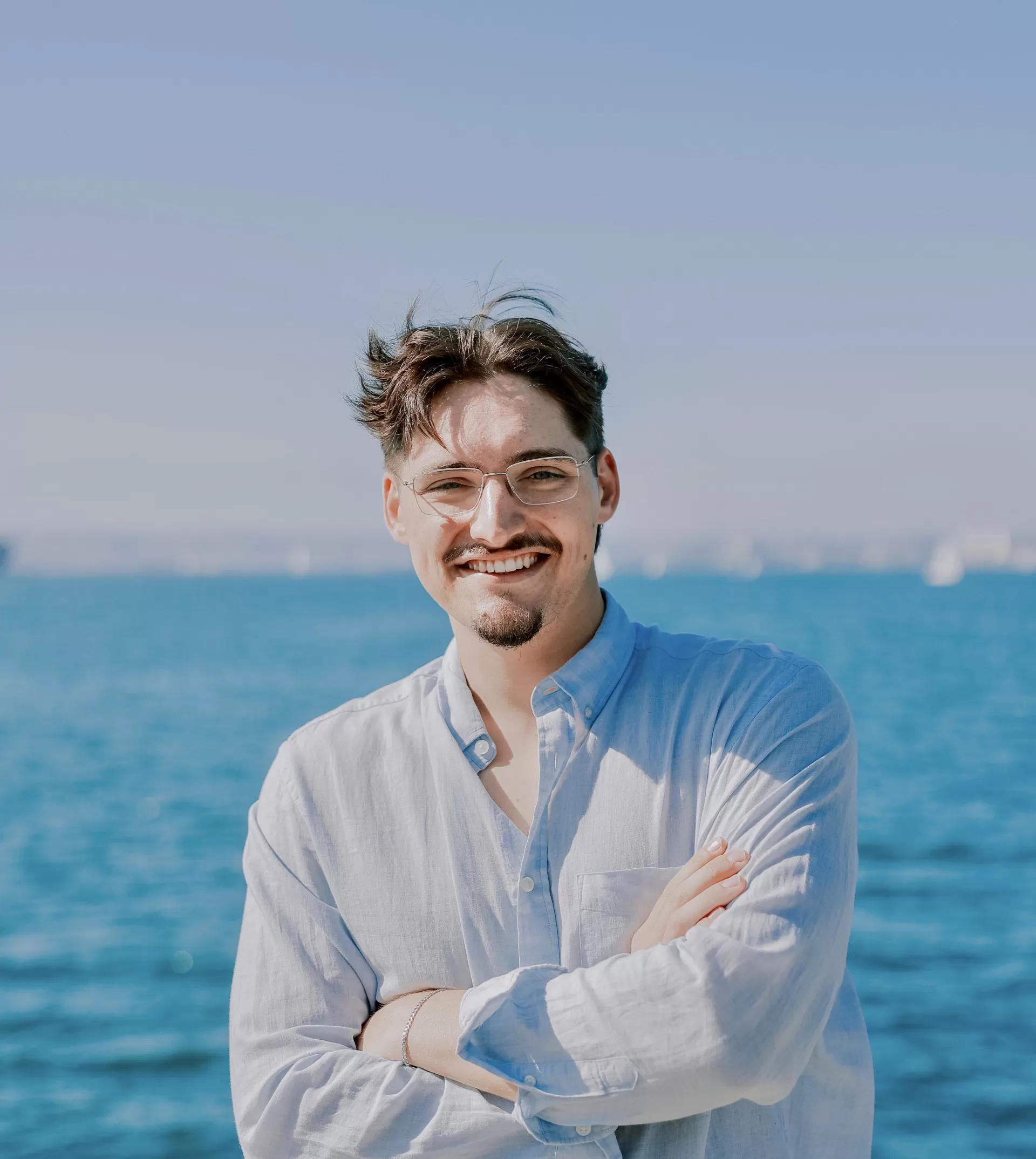
Faustus Tuschmann, a master's student from Heidelberg, is fascinated by the complexity of the human brain. His research focuses on prion diseases, glioblastomas, and epigenetic mechanisms. In his research, he seeks the molecular causes of neurodegenerative diseases and potential future therapies.
The human brain never ceases to amaze. The way individual neurons are connected with one another is simply incredible. We often don’t even understand what’s happening there exactly. Take Purkinje cells, for instance. On average, each one forms around one hundred thousand connections to other neurons, which means having to process all those signals – in a cell body that measures just 40 micrometers. I find facts like these about the brain’s complexity fascinating. But I’m even more excited about how our brains make us human and to what extent this complexity sets us apart from other animals. Paradoxically, it’s also our brains’ complexity that makes us susceptible to neurodegenerative diseases like Alzheimer’s and Parkinson’s. I would like to understand this relationship at the molecular level.
I would like to make fundamental discoveries that will help humankind one day.
As part of my master’s program, I conducted research on prion diseases at the Scripps Research Institute in San Diego. In these diseases, proteins fold abnormally, triggering a chain reaction that kills off huge numbers of neurons in the brain. We studied small organic molecules that promote the breakdown of these misfolded proteins. It is hoped that this research will lead to a treatment. First-in-human clinical trials could start early in 2027.
I would like to make fundamental discoveries that will help humankind one day. For my master’s thesis I am researching glioblastoma, the most common malignant primary brain tumor in adults and one of the most aggressive forms of brain cancer, at the German Cancer Research Center (DKFZ) in Heidelberg. Our research group is investigating how gene-regulatory mechanisms control DNA in potential cancer cells and how these regulatory mechanisms are disrupted at the onset of cancer. This research is essential for understanding the pathology of the disease, even if an effective treatment is still a long way in the future.
Even as a child I was enthralled by the diversity of nature.
When I first heard about DNA at high school, I was fascinated by the fact that every living thing carries this type of genetic material and yet different organisms develop in such different ways. That’s why I decided to study molecular biology. Today, cutting-edge lab technologies and bioinformatic methods can help us gain a systematic understanding of how life in all its diversity is formed at the molecular level.
For my PhD, I would like to focus on epigenetics and its role in the development of neurodegenerative diseases. This research field, which is still in its infancy, investigates chemical changes to DNA that don’t change its basic structure, but make slight modifications that influence how the cell reads it. These epigenetic modifications can occur as a response to changes in the environment.
With epigenetic editing methods, it is possible to make precise modifications to people’s genetic material that are confined to one generation and not passed on. If, for instance, an airborne pollutant contributes to neurodegeneration, one could decode the underlying epigenetic mechanisms and use epigenetic editing to return the affected neurons to their normal state. This opens up completely new options for therapy development, which is something I would like to be involved in.
It’s very important for me to remain unbiased in my research. Even if the majority of previous studies appear to contradict a hypothesis, you should still keep a resolutely open mind. It’s not always easy, but it’s worth staying curious.
I get the energy I need for all this from my social circle and from playing lots of sport. When I’m mentally exhausted from thinking about science, it does me good to tire myself out physically at the gym or with the running club. And I enjoy singing. Last semester, I sang Verdi’s Requiem with the Heidelberg University choir.

Faustus Tuschmann is doing an MSc in molecular biosciences at Heidelberg University, with a focus on molecular and cell biology. For his thesis, he is conducting research on glioblastoma at the German Cancer Research Center (DKFZ) in Heidelberg. He previously spent time at the Scripps Research Institute in San Diego and completed a BSc in biosciences at Heidelberg University. He was awarded a Wübben Foundation Student Grant in 2025/26 and is an alumnus of the first cohort of 2023/24.