#12 Ute Frevert
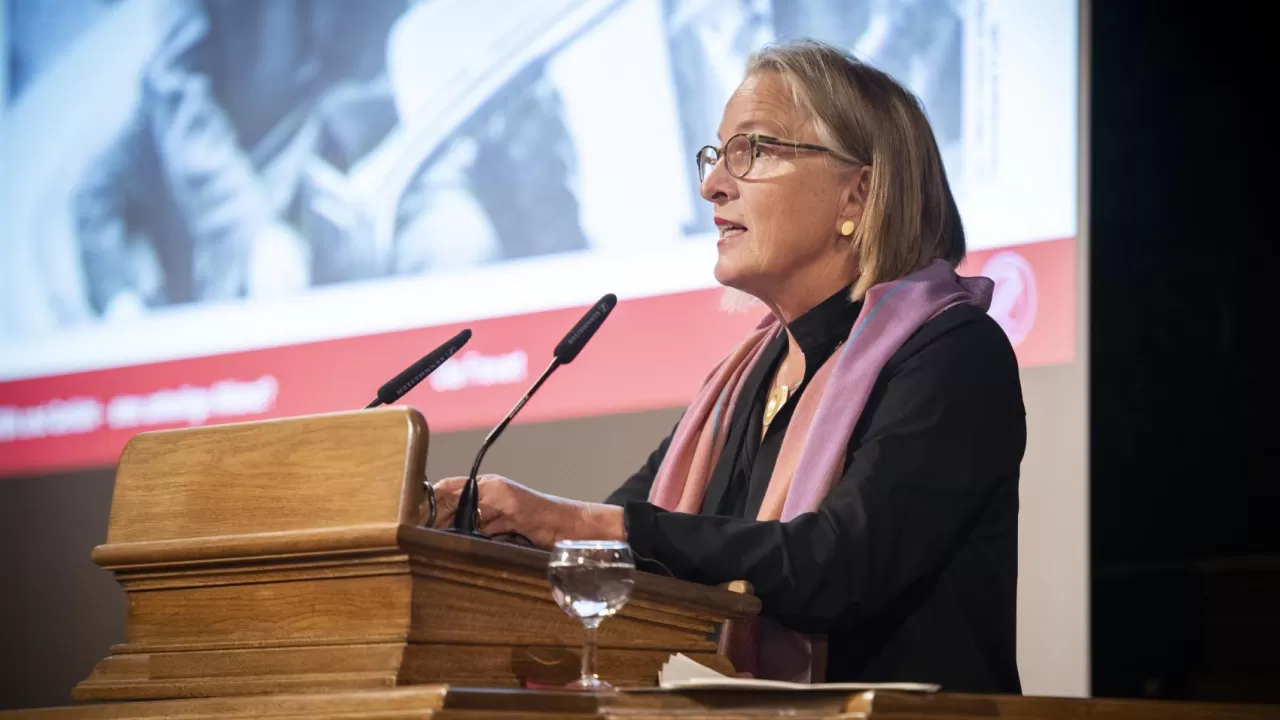
On October 27, 2022, Ute Frevert, the historian and former Director of the Max Planck Institute for Human Development, Berlin, gave a lecture entitled “Politics and Feelings: An Unholy Alliance” for the Marsilius-Kolleg in the Great Hall at Heidelberg University.
Frevert began by stating it was incorrect to assume emotions had only come to dominate politics in the present day. Previously, under absolutism, rulers had presented themselves as benevolent, paternal overlords caring protectively for their subjects with warmth and affection. In nineteenth-century liberalism, emotions had then been wielded like weapons in political disputes over matters of principle. This tendency had culminated in the Weimar Republic, where fierce controversies had raged about the fundamentals of mutually antagonistic world views. Quite different mechanisms operated where affects were exploited in dictatorships. National Socialism and Stalinism demonstrated how stylized portrayals of rulers were designed to evoke emotional effects, sway the masses, and elicit broad identification with autocratic figures. By contrast, Frevert contended, the still-young Federal Republic of Germany (FRG) had, with its programmatic sobriety, distanced itself from the mass parades of the Nazi state. Through into the 1970s, debates in parliament and the media had been conducted in a pointedly objective tone despite the profound disagreements over many issues, especially relations with the German Democratic Republic (GDR), the policy of détente, and the treaties signed with Eastern Bloc states. During this phase of contemporary history, it had only been apparent that politicians acted as “managers of emotion” from the manner in which election campaigns were fought, a situation in which voters’ attachment to particular parties was at stake. Unlike in East Germany, which had employed state-organized mass events to induce powerful emotional responses, the street had not been the stage where politics was acted out in the early days of the Federal Republic.
This had only changed in the late 1970s and early 1980s with the peace movement, which had used the affect of fear to drive and shape political conflicts. Frevert talked of the “well-tempered emotional politics of bourgeois society” practiced during this period, a phenomenon encouraged by the general valorization of emotions associated with a new subjectivity. The prevailing consensus about the rules of democracy had first been broken by the radical left with the various forms of resistance to which they resorted, even going as far as violent terrorism. Today, it was mainly the right – the Alternative for Germany (AfD), the Patriotic Europeans against the Islamization of the West (Pegida) movement, and the Reichsbürger seeking to restore the old German Empire – who wished to shake off democratic values, brook no compromise, and articulate purely subjective demands. The blurring of the boundaries that defined democratic values was making it possible for feelings to function as vehicles for group identity and transmute into fundamentalist propaganda for positions that no longer set store by consensus.
Ute Frevert closed her lecture with a passionate appeal for emotions to have a place in the political sphere, stating they were necessary because politics dealt with existential issues and problems that were not amenable to resolution by rational arguments alone. Nonetheless, the basic question was still how expressions of emotion could be contained and sublimated politically without paying the price of a “halving of democracy” (Rainer Forst). The solution lay in the perpetual refinement of our culture of debate, which might allow space for affects, but should not abandon the consensus about our democratic values. Only in this way would we be able, as Ute Frevert put it, to strengthen the power of feelings where they could be reconciled with democracy while, at the same time, weakening their destructive dynamics.
Peter-André Alt
Date October 27, 2022
Language German
Length 50 mins
Title, series Politik und Gefühl, Marsilius-Vorlesung
Video Universität Heidelberg