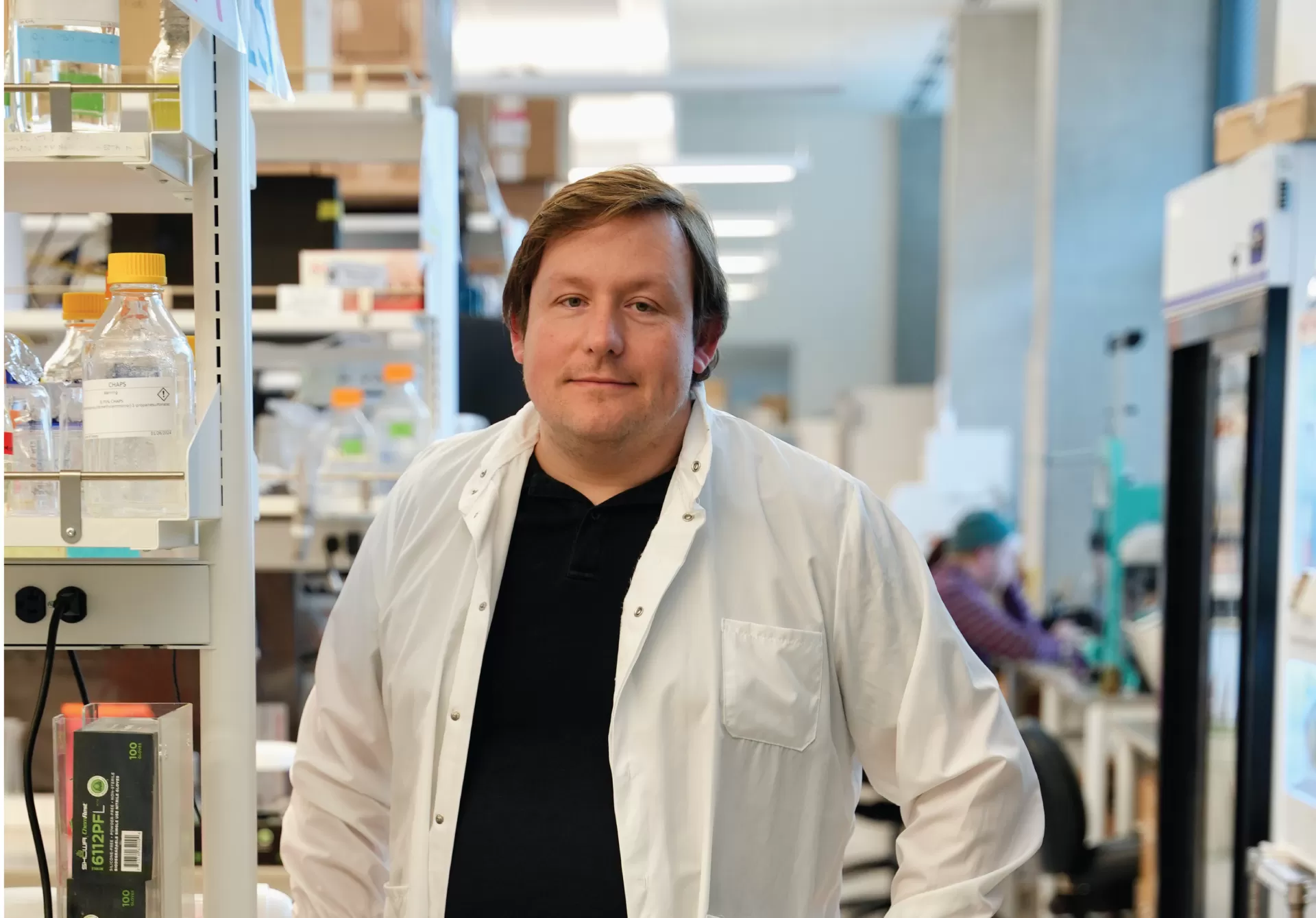
Thomas Schlichthärle
Proteins are the building blocks of life and are responsible for countless processes in the human body. The latest AI models are capable of analyzing and optimizing proteins in unprecedented ways. Biochemist Thomas Schlichthärle is using these models to design synthetic proteins capable of forming the basis for new medical treatments.
Thomas Schlichthärle sees biology as a system to be optimized. The system components that he’s particularly interested in are all the proteins that perform vital tasks in human cells. When they malfunction, it can lead to diseases.
“If we understand the mechanisms of these protein machines and why they are defective, we can repair them or even build better proteins than the ones produced in nature,” says Schlichthärle. Instead of using Petri dishes, pipettes, and microscopes, this biochemist employs the latest artificial intelligence (AI) models. His specialist field, protein design, sits at the interface of biochemistry, structural biology, medicine, and computer science. It is the art of imitating nature to create proteins that perform a desirable new function, so as to steer cell processes towards healthy outcomes.
“AI has accelerated the possibilities for protein design dramatically. We can now simply try something out, design a protein, and predict its three-dimensional structure – and therefore its function – on the computer,” says Schlichthärle, who took up the Chair for AI-guided Protein Design at the Technical University of Munich (TUM) in June 2025. “Then we can see whether the protein will be well folded or not, and can make further improvements to it with the help of AI models, before producing it in the lab and testing it to see whether it functions as intended.”
With protein design methods, we get the cells to do what we tell them.
For instance, he and other protein designers have succeeded in reprogramming nerve growth factor (NGF) in such a way that it continues to fulfill the task that medics want it to perform – namely repairing damaged nerves – but without causing pain. To do this, the researchers developed a new protein that no longer binds to a pain receptor but otherwise exhibits the same activity as the original NGF. “It can be used anywhere where peripheral nerves have been damaged and need to be regenerated,” says Schlichthärle. And the patients don’t feel any pain.
30,000 potential protein structures for one perfect candidate
So how exactly do you go about making an optimized protein? Schlichthärle’s team follows a method that involves three different AI models. The first one, a diffusion model, generates up to 30,000 protein structures on the basis of unstructured data and certain instructions – such as the instruction not to bind to a particular pain receptor. A second AI model finds the underlying amino acid sequence which ensures that the protein folds into its three-dimensional structure. Finally, a powerful structure-prediction model, AlphaFold, tests the effectiveness of the designed proteins.
“Using in-house programs, we select the best proteins and feed them back into the first model,” Schlichthärle explains. After two or three passes, the researchers are left with 96 promising protein candidates that can then be produced in the lab with the aid of bacteria and tested to see how they function.
From ambulance driver to protein designer
Schlichthärle came to protein design through medicine. He decided back when he was driving an ambulance during his gap year that he wanted to help people – but as a researcher, not as a doctor. He studied molecular medicine in Tübingen, followed by bioengineering in Dresden. He wrote his master’s dissertation on DNA nanotechnology at the Wyss Institute for Biologically Inspired Engineering in Boston. His PhD, which he completed at the Max Planck Institute of Biochemistry in Martinsried, focused on labeling proteins with molecular “tags” so that they can be identified under high-resolution microscopes.
It bothered me that we can only see a third of the proteins in a cell.
He programmed mathematical simulations to close the gaps. Then, in 2017, he heard about the possibilities offered by protein design, in a lecture given by US biochemist David Baker. “I immediately knew that we could build much better tags using his methods,” he says.
Schlichthärle spent nearly five years as a postdoc working in Baker’s lab at the University of Washington. He absorbed the protein design methods like a sponge. In 2024, during his last year in Seattle, he woke up at four o’clock one October morning, looked at his phone, and saw the news: The Nobel Prize in Chemistry had been awarded to David Baker for his achievements in computational protein design. The other half of the prize went to Demis Hassabis and John Jumper at Google DeepMind for the development of AlphaFold2, an AI model that can predict the 3D structure of proteins from their amino acid sequences.
“After the press conference, David came into the lab and we celebrated together,” says Schlichthärle. It was clear to all of them that the Nobel Prize was a beginning, not an end. Protein design had reached the stage where it could be used to tackle all kinds of real-life problems, from developing new treatments to creating new enzymes that can break down the PET in plastic bottles and be deployed in other industrial applications.
We want to make the tags available through a startup and share the associated protein sequences openly with the research community.
Schlichthärle moved from Seattle back to Munich. His time on the West Coast of the United States had provided a motivation boost – partly because of the Nobel Prize, but also because David Baker had made a deep impression on him as an outstanding researcher and leader. “There were around 100 people in his group, but he was always there for us when we had questions, and at lunchtime, when he would sit with us in the kitchen to eat his salad,” he recalls.
A solid basis for a virtual cell
Now, at TUM, Schlichthärle plans to use protein design methods to develop highly efficient molecular tags to label and visualize 90% of the proteins present in cells . “We want to make the tags available through a startup and share the associated protein sequences openly with the research community,” he says.
Once the foundations are in place, Schlichthärle plans to work with clinicians to design new proteins. Proteins for new cancer immunotherapies, for example. Or proteins that can enable efficient production of specialized cells from stem cells to test the effectiveness of new drugs. He has a future vision of a virtual stem cell that will be stimulated by newly designed growth factors on a computer, instead of in a lab. It will be a kind of digital Petri dish that can predict real cell reactions. In other words, nothing less than a whole new basis for drug development.
«Many international researchers don’t even know what’s possible in Germany» Read the interview with Thomas Schlichtärle to find out why he decided to return to Germany, and to learn about his views on the German science and research system.
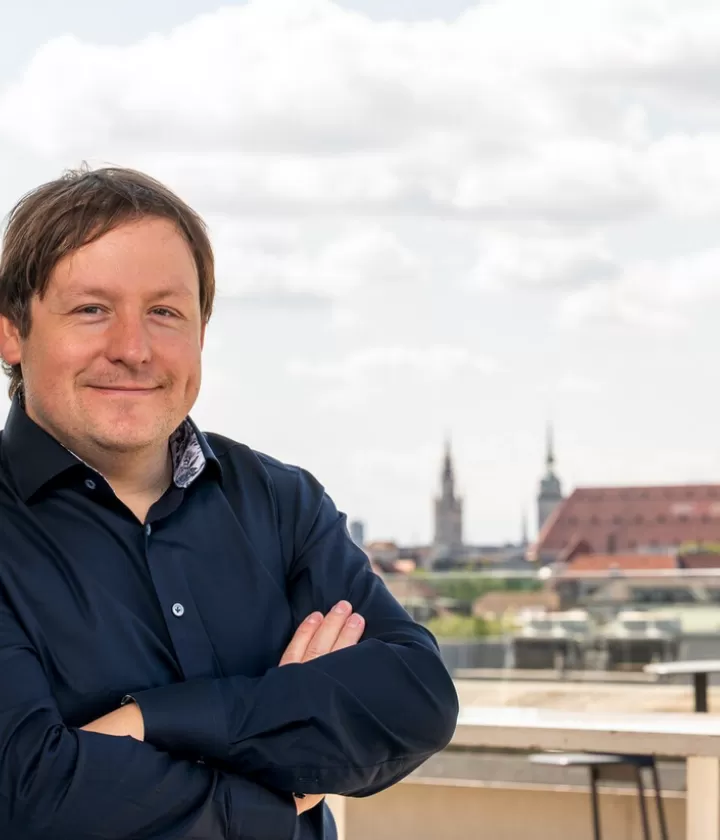
Thomas Schlichthärle is Professor for AI-guided Protein Design at the Technical University of Munich (TUM), a post he has held since June 2025. Previously, he completed his PhD at the Max Planck Institute of Biochemistry in Martinsried and Ludwig Maximilian University (LMU) in Munich, and worked as a postdoc in the laboratory of Nobel laureate David Baker at the University of Washington. He returned to Germany when he received a grant through Wübben Stiftung Wissenschaft’s Appointment Accelerator program.
Since 2025
Tenure-Track-Professur for AI-guided Protein Design at the Technical University of Munich
2021
EMBO Postdoctoral Fellowship
2020 - 2025
Postdoc, David Baker Lab, University of Washington, Seattle
2014 - 2020
PhD in Biochemistry, Max Planck Institute of Biochemistry / Ludwig Maximilian University Munich
2014
Roland Ernst Grant