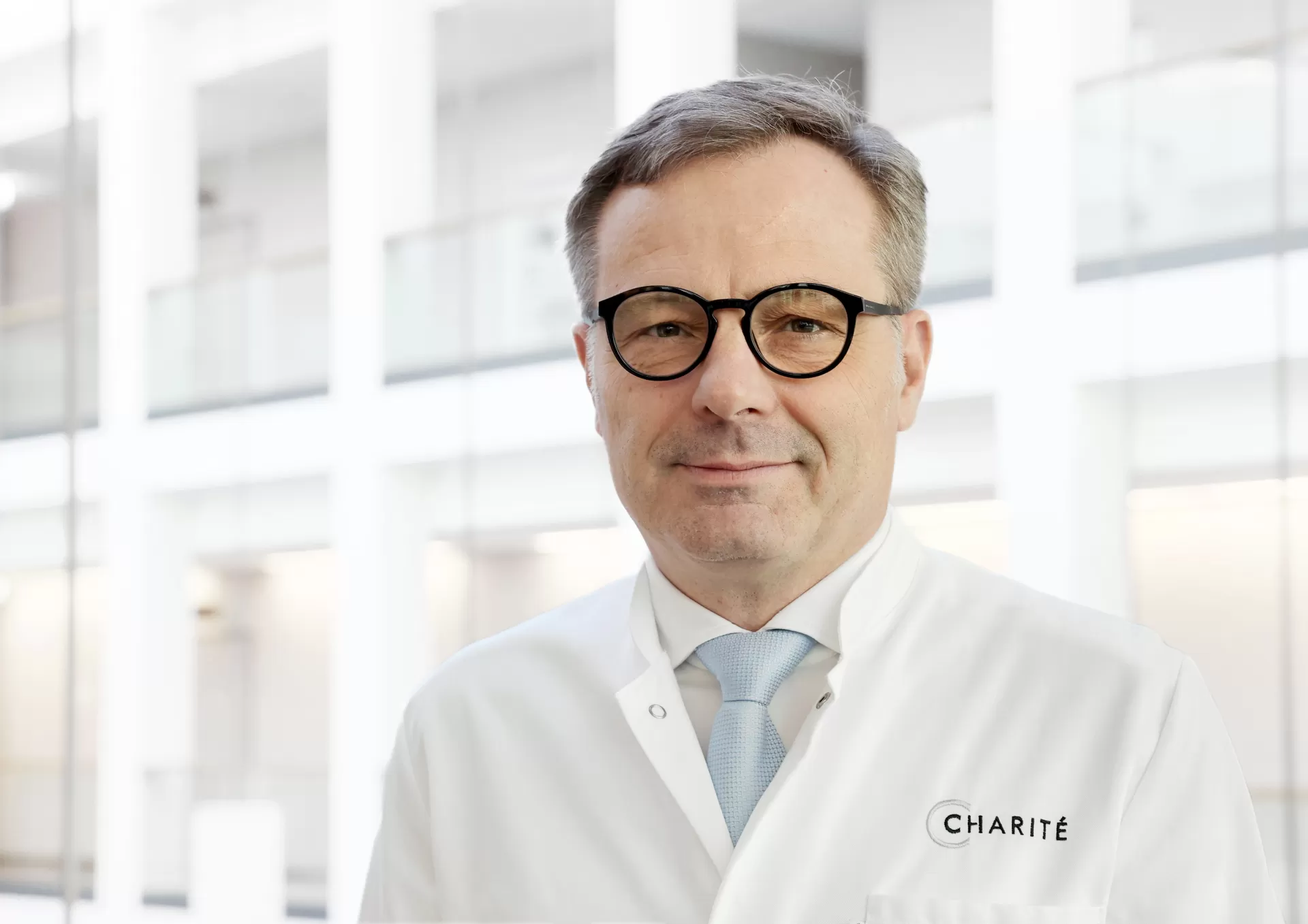
International expert on spinal cord injuries moves to Berlin
Jan Schwab assumed the newly established Professorship for Clinical and Experimental Paraplegiological Research at Charité – Universitätsmedizin Berlin on 1 January. This joint initiative is in collaboration with the Unfallkrankenhaus Berlin (ukb). The appointment includes the roles of Medical Director of the Clinic for Spinal Cord Injuries and Paraplegiological Research, and Director of Experimental Paraplegiological Research. Wübben Stiftung Wissenschaft made this appointment possible through its professorship program, which aims to recruit outstanding international researchers.
The new professorship is an integral part of the strategic partnership between Charité and ukb, with the aim of building an internationally visible center for research, teaching, and clinical care for spinal cord injuries. On the Charité side, it is linked with the Clinic for Neurology and Experimental Neurology and closely networked with the Center for Musculoskeletal Surgery (CMSC). Regarding the joint professorship of the cooperation partners, Prof. Schwab emphasizes: “The new clinically and experimentally anchored professorship will act as a catalyst: Together with strong partners, we can ask more questions, test hypotheses, and get answers to learn faster. The combination of excellent medical care for patients with spinal cord injuries at ukb together with cutting‑edge scientific research at Charité provides ideal conditions and great potential. None of this would have been possible without the Wübben Foundation.”
Internationally recognized expert comes to Berlin
Prof. Schwab most recently served as Medical Director of the Belford Center for Spinal Cord Injury, was a Tenured Professor of Neurology at The Ohio State University (USA), and held the William Hunt and Charlotte Curtis Chair in Neuroscience there. He is internationally recognized as a leading expert in the neuroimmunology of spinal cord injuries. His work on immunological dysfunction after spinal cord damage has been widely honored, including by the National Institutes of Health (NIH/NINDS). On linking clinical care with research, he states: “With the newly established integrated research and treatment center for spinal cord injuries, it will be possible to investigate clinical questions directly for their underlying mechanisms. A better understanding of these mechanisms is the logical prerequisite for treating spinal cord injuries more causally and therefore more effectively in the future.” He adds: “In combination with the specialized multidisciplinary care for patients with paraplegia, this professorship opens new opportunities to translate experimental findings more quickly into high‑quality, randomized clinical trials — with the clear goal of sustainably improving treatment.”
Significant impetus for paraplegiological research in Germany
The aim of the new professorship is to improve neurological and functional regeneration after spinal cord injuries by developing novel therapeutic approaches. This involves identifying clinically relevant and modifiable regeneration‑inhibiting mechanisms — so‑called “recovery confounders.” The occurrence of these mechanisms is to be minimized to protect the regenerative capacity of the injured spinal cord. In addition to experimental basic research and the development of innovative treatment strategies, particular focus is placed on translation into early clinical trials, as well as teaching and the support of early‑career researchers. The establishment of a new research and treatment center for spinal cord injuries and clinical and experimental paraplegiological research is one of the most significant developments in German academic paraplegiological research in recent decades.
Research focus: neuroimmunology and regeneration
A central research focus of the neurologist is on immune dysfunction caused by spinal cord injury, which can affect the entire body. Spinal cord injuries can not only lead to the characteristic loss of muscle function and sensation, but also to a systemic immune deficiency caused by disrupted communication between the nervous system and immune system. This immune suppression, in turn, increases the risk of serious infections such as pneumonia and sepsis, which remain the leading causes of death, and actively impedes neurological regeneration. Prof. Schwab emphasizes: “Paraplegia means far more than the loss of mobility or sensation. It transforms from an acute spinal cord injury into a dysfunction that can affect the entire body — the so‑called 'Spinal Cord Disease.' With the integrative approach, regeneration‑inhibiting complications come into focus in order to protect and improve both survival and neurological functional gains for patients.”
Brief biography
Jan Schwab was born in Stuttgart. After completing his high school diploma and civilian service, he studied medicine at Eberhard Karls University in Tübingen, where he also earned his M.D. in 2000 and, in 2003, his doctorate at the Max Planck Research School in Neurosciences following stays abroad in Tel Aviv and New York. He completed his habilitation there in 2004. This was followed by research stays in Paris (CNRS, Marie Curie EU Fellowship) and as a DFG fellow in Boston at Brigham and Women’s Hospital. At the Clinic for Neurology and Experimental Neurology at Charité, he completed his specialist training in neurology, where he also conducted research on spinal cord injuries as a group leader from 2007 to 2014. From 2012 to 2013, he worked as a senior physician in the Department of Spinal Cord Injuries at ukb. In 2014, he was appointed to the William Hunt and Charlotte Curtis Chair at The Ohio State University (USA) and led the Spinal Cord Injury Section of the Department of Neurology there. In 2016, he became Program Director of a national U.S. excellence program’s center for research and treatment of spinal cord injury. He was a founding member of the Belford Center for Spinal Cord Injury in 2018 and has served as its Medical Director ever since. As a founding member and Scientific Director, he has advised the international Wings for Life Foundation for spinal cord research since 2004 and has been responsible for strategic development.
About Charité
Charité – Universitätsmedizin Berlin is the joint medical faculty of Freie Universität Berlin and Humboldt‑Universität zu Berlin. With around 100 clinics and institutes, it is one of the largest university hospitals in Europe. With 3,293 beds across three clinical campuses, Charité provides outpatient care to around 822,600 patients annually in Berlin and Brandenburg, as well as around 143,800 inpatient and day‑patient treatments.
About ukb
BG Klinikum Unfallkrankenhaus Berlin (ukb) is a highly specialized clinical center for the rescue and rehabilitation of patients from across Germany. In specialized disciplines such as the treatment of burn, spinal cord, and hand injuries, ukb holds a leading international position. More than 100,000 patients are treated there annually. Emergency care for acutely injured or ill patients is provided in one of the largest and most modern emergency departments in Germany. ukb is part of the BG Kliniken group — the largest non‑university public hospital group. The BG Kliniken are sponsored by statutory accident insurance institutions and employers’ liability insurance associations.
About Wübben Stiftung Wissenschaft
Wübben Stiftung Wissenschaft is a private funding foundation based in Berlin. Its goal is to strengthen Germany as a location for science and research by supporting outstanding scientists at various career stages. With its professorship programs, the foundation particularly promotes distinguished appointments of international researchers to German universities.