#11 Stefan Hell
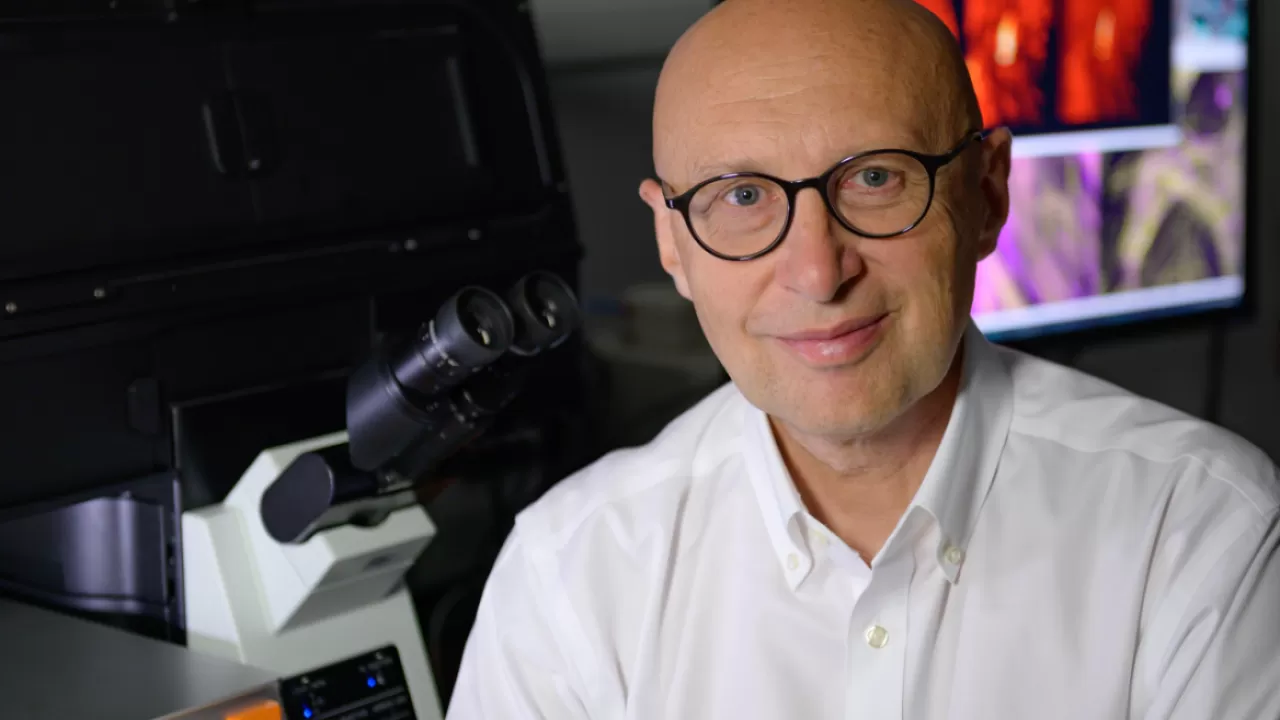
Nobel laureate Stefan Hell, a physicist specializing in microscopy and a director of the Max Planck Institute for Multidisciplinary Sciences in Göttingen, gave a talk on March 25, 2023, at the Center for Art and Media (ZKM) in Karlsruhe on “How to overcome a scientific limit”. In this lecture, Hell is very open about his academic career and offers insights into how he sees himself as a basic researcher.
Having grown up in German-speaking Transylvania, he moved to West Germany after completing his school education at the same high school as Herta Müller, who won the Nobel prize for literature. He studied physics at Heidelberg and, while still a doctoral student, started exploring problems associated with microscopy. The electron microscope has long been thought to offer the highest technical standard for optical penetration of microstructural elements, but it does not work when it comes to analyzing living cells – primarily their proteins – because, for medical reasons, living cells cannot be properly prepared for analysis under the microscope. The older light microscope, which employs laser beams and focuses on the desired objects with the help of a lens, is of more use in this area because the proteins under investigation can be labeled with fluorescent cells and then made visible with the help of light. However, the problem with this method is that light waves diffract, which means they only ever pick out larger groups of proteins, rather than individual ones.
It was in 1993, while working as a postdoc in Turku, Finland, where, unlike in Germany, there was a greater interest in questions relating to light microscopy, that Stefan Hell succeeded in making the key discovery in this field. Light can not only pick out certain structures, but can also be used to dim them. If the light beam on the whole group of proteins is adjusted in such a way that the majority of the cells, those that are irrelevant for the research, are dimmed, it is possible to isolate the desired protein and highlight it within the light wave. Using this technique, known as STED, it is possible to build reasonably priced laser microscopes that can analyze proteins selectively, in a way that is not possible with an electron microscope. This was to become an important milestone in cancer research.
It was many years before Stefan Hell was able to convince the expert community of his discovery. For a long time, he had no job and lived precariously, traveling to conferences at his own expense and submitting funding applications to no avail. It was only in the second half of the 1990s, following his habilitation, that he was appointed to the position of group leader at the Max Planck Institute in Göttingen, where he became a director in 2002. Looking back, he says what motivated him above all was the feeling that he had to do what gave him the greatest intellectual satisfaction, even if his research was ignored for some time.
He finishes his presentation with two messages: Even in research, it is sometimes difficult to overcome ingrained prejudices by breaking new ground. And: Only basic research driven by curiosity leads to breakthroughs that eventually prove economically profitable as well. Anyone who thinks solely in terms of purposes and defines their goals purely in terms of potential benefits will be less creative.
Curious minds do make a difference – Nobel laureate Stefan Hell bears out the Wübben Stiftung Wissenschaft motto!
Peter-André Alt
Date March 25, 2023
Language German
Length 62 mins
Title, series Stefan Hell: Wie man eine wissenschaftliche Grenze überwindet...und was man daraus machen kann, Renaissance 3.0
Video ZKM Karlsruhe